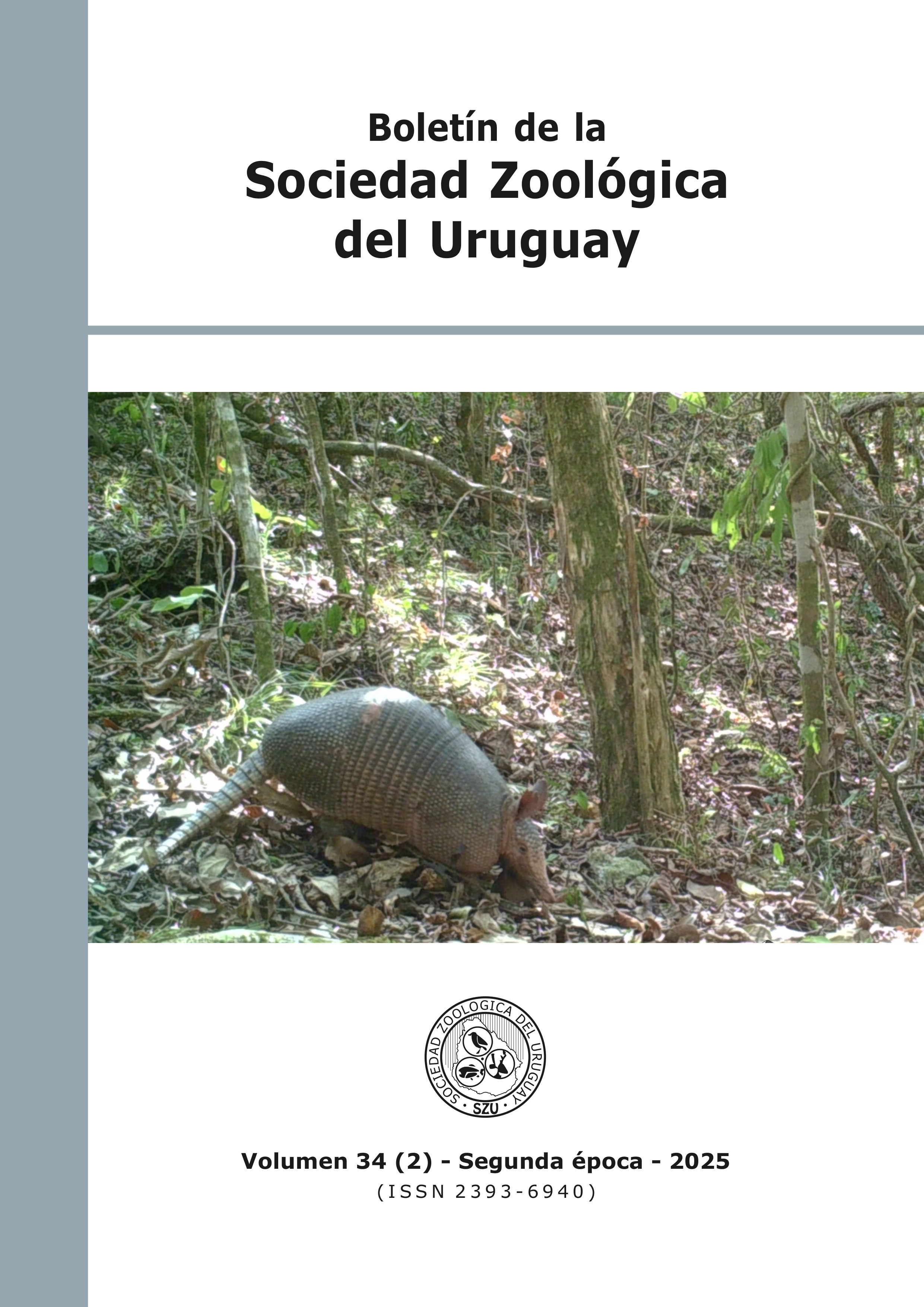
EL GRAN ESCAPE: LA TANATOSIS COMO UNA EFICAZ ESTRATEGIA ANTI-DEPREDADOR EN Leptodactylus sp. CONTRA Philodryas patagoniensis EN EL NORDESTE DE BRASIL
DOI:
https://doi.org/10.26462/34.2.6Palabras clave:
Mecanismos de defensa, Bosque Atlántico, Serpiente, AnuraResumen
Los anfibios presentan diferentes mecanismos de defensa contra la depredación. Aquí reportamos un caso de depredación no exitosa por parte de Philodryas patagoniensis sobre Leptodactylus sp. asociado a una defensa a través de un comportamiento de tanatosis.
Descargas
Citas
Alvarez, J.S., & Wilcox, J.T. (2022). Anaxyrus boreas (Western Toad). Death feigning. Herpetological Review, 53(3), 461-462.
Barbosa, V.N., Amaral, J.M.D.S., Santos, S.S., Silva, E.F., Linnik, J.O.H.N., & França, F.G.R. (2022). An unusual record of ophiophagy and necrophagy in the common boa Boa constrictor in the Brazilian Atlantic Forest. Herpetological Bulletin, 159(2022), 44-45.
Chuliver, M., & Scanferla, A. (2024). Paedomorphosis and retention of juvenile diet lead speciation in a group of Neotropical snakes (Colubroides - Philodryadini). Scientific Reports, 14(1), 10071.
Costa, W.P., & Trevelin, C.C. (2020). Congeneric predation of Leptodactylus fuscus (Schneider, 1799) by Leptodactylus chaquensis Cei, 1950 (Anura, Leptodactylidae). Herpetology Notes, 13, 109-111.
Ferreira, R.B., Lourenço-de-Moraes, R., Zocca, C.Z., Duca, C., Beard, K.H., & Brodie Jr, E.D. (2019). Antipredator mechanisms of post-metamorphic anurans: a global database and classification system. Behavioral Ecology and Sociobiology, 73, 1-21.
Frost, D.R. (2024). Amphibian Species of the World: An Online Reference. Version 6.2 (4 Sep 2024). American Museum of Natural History, New York, NY. Accessible at: https://amphibiansoftheworld.amnh.org/index.php
. (Accessed on June 25, 2024).
Gonzalez-Candia, F.J. (2023). Rhinella atacamensis (Atacama Toad). Death feigning. Herpetological Review, 54(1), 19-20.
Haddad, C.F., Toledo, L.F., Prado, C. P., Loebmann, D., Gasparini, J.L., & Sazima, I. (2013). Guia dos anfíbios da Mata Atlântica: diversidade e biologia. Anolis Books.
Hansen, L.S., Gonzales, S.F., Toft, S., & Bilde, T. (2008). Thanatosis as an adaptive male mating strategy in the nuptial gift–giving spider Pisaura mirabilis. Behavioral Ecology, 19(3), 546-551.
Hartmann, P., & Marques O. (2005). Diet and habitat use of two sympatric species of Philodryas (Colubridae) in south Brazil. Amphibia-Reptilia, 26(1), 25-31.
Humphreys, R.K., & Ruxton, G.D. (2018). A review of thanatosis (death feigning) as an anti-predator behaviour. Behavioral ecology and sociobiology, 72(22), 1-16.
IUCN. 2024. The IUCN Red List of Threatened Species. Version 2024-1. Accessible at: https://www.iucnredlist.org
. (Accessed on September, 24, 2024).
Klank, J., Protti-Sánchez, F., Triana, F., & Stynoski, J.L. (2023). Thanatosis in the Floating Rocket Frog, Silverstoneia flotator from Costa Rica. Herpetology Notes, 16, 349-351.
Lopes, A.G., Sousa J., Tavares-Pinheiro, R., & Costa-Campos, C. (2021). Leptodactylus macrosternum Miranda-Ribeiro, 1926 (Anura: Leptodactylidae) preyed upon by Lygophis lineatus (Linnaeus, 1758) (Serpentes: Dipsadidae), with notes on its distress call. Herpetology Notes, 14, 949-953.
Lourenço-de-Moraes, R., Ferreira, R.B., Mira-Mendes, C.V., Zocca, C.Z., Medeiros, T., Ruas, D.S., ..., & Solé, M. (2016). Escalated antipredator mechanisms of two neotropical marsupial treefrogs. Journal of Herpetology, 26(3), 237-24.
MacDonald, L. (1973). Attack latency of Constrictor constrictor as a function of prey activity. Herpetologica, 29(1), 45-48.
Machado Filho, P.R. (2015). Evolução do hábito alimentar e utilização do substrato pelo gênero Philodryas Wagler, 1830. Dissertação de Mestrado. Universidade Estadual Paulista “Júlio de Mesquita Filho”, São José de Rio Preto.
Miyatake, T., Katayama, K., Takeda, Y., Nakashima, A., Sugita, A., & Mizumoto, M. 2004. Is death-feigning adaptive? Heritable variation in fitness difference of death-feigning behaviour. Proceedings of the Royal Society B: Biological Sciences, 271(1554), 2293-2296.
Quintela, F.M., & Loebmann, D. (2019). Diet, sexual dimorphism and reproduction of sympatric racers Philodryas aestiva and Philodryas patagoniensis from the coastal Brazilian Pampa. Anais da Academia Brasileira de Ciências, 91(1), e20180296.
Sales, R., Jorge, J., Kokubum, M., & Freire, E. 2015. Predation of Leptodactylus troglodytes by Leptodactylus macrosternum (Anura: Leptodactylidae) in the Brazilian Caatinga. Herpetology Notes, 8, 421-423.
Santana, D., Espinóza, F.A., Giroux, A., Maruyama, C., & Borges, F.L. (2019). Predation of Mussurana bicolor (Serpentes, Dipsadidae) upon Leptodactylus podicipinus (Anura, Leptodactylidae) in the Pantanal, Brazil. Herpetology Notes, 12, 281-282.
Santiago, D.H. 2021. New record of Thamnodynastes strigatus (Günther, 1858) (Snakes: Dipsadidae) preying on Leptodactylus macrosternum Miranda-Ribeiro, 1926 (Anura: Leptodactylidae), with comments on antipredator mechanisms. Herpetology Notes, 14, 1151-1153.
Santos, E.S., Albuquerque, R.D., & Teles, D.A. (2024). Leptodactylus troglodytes (Pernambuco White-Lipped Frog). Defensive behavior. Herpetological Review, 55(2), 242.
Santos-Jr, I., Rodrigues, G., Souza, D., & Alves-Coêlho, T. (2022). Predation on Leptodactylus fuscus (Anura: Leptodactylidae) by Erythrolamprus reginae (Serpentes: Dipsadidae) in the Brazilian Amazon. Herpetology Notes, 15, 649-651.
Segalla, M.V., Berneck, B., Canedo, C., Caramaschi, U., Cruz, C.G., Garcia, P.D.A., ..., & Langone, J.A. (2021). List of Brazilian amphibians. Herpetologia brasileira, 10(1), 121-216.
Silva, K.A.C., Lourenço-de-Moraes, R., Amaral, J.M.S., Silva, E.F., Barbosa, V.N., & França, F.G.R. (2024). Efficiency of death feigning: Antipredator mechanisms in Pristimantis ramagii (Anura: Strabomantidae) during a predation attempt by Chironius flavolineatus (Serpentes: Colubridae). Revista Latinoamericana de Herpetología, 7(4), e1059-132.
Toledo, L.F., Sazima, I., & Haddad, C.F.B. (2010). Is it all death feigning? Case in anurans. Journal of Natural History, 44(31-32), 1979-1988.
Toledo, L.F., Tozetti, A.M., & Zina, J. (2005). Leptodactylus labyrinthicus (Pepper frog): Repertoire of defensive behaviour. Herpetological Bulletin, 91, 29-31.